Now, the interesting question is whether those lines will keep falling, and what might rise in their place.
More.
Update: For those who don’t know about google ngram. And for a more enlightening case study:
and especially:
Now, the interesting question is whether those lines will keep falling, and what might rise in their place.
More.
Update: For those who don’t know about google ngram. And for a more enlightening case study:
and especially:

Your point about the role of space and place in neoliberalism is spot on. What is fascinating about the reading I’ve been doing about financial imaginaries, and their slow diffusion into our everyday thought, is that the abstraction required–of the individual, of their desires, and of the income that they earn (and the income they accumulate, because when you put on your finance glasses, all assets [“capital”] become nothing more than future income streams)–also entails a second-order abstraction from place or, more precisely, a conceptual annihilation of place.
“Making,” in this view, is just a combination of income streams to create further income streams, which are then distributed to the participants; consumption, too, happens nowhere, in an existential vaccuum, precisely alone; markets are not made of people or of computers or of actions or of anything at all, but simply exist as universal, ambient calculating devices, receiving and sending inputs and outputs without requiring any actual interface with the consuming, accumulating subject. We cannot learn anything about our wants, which have no where; we can learn only about how to feed them, anywhere, and only through the market, which is everywhere.
Now, this is almost but not quite hyperbole: it is not per se that e.g. the work of economic geographers is irrelevant. There is lip service, in the probabilistic characterization of futures in terms of “states of the world” that will determine the payouts from those assets, to the fact that these states will actually come to occur in a world. But the value of the “state” is in its realized income, not in the world. You can want to watch a Tahitian sunset, but the existence of Tahiti is irrelevant, reproducible, peripheral. The bodies, actions, performance, work, interpretations, decisions–all these, from within the perspective of the system, are obscene. And what is place but a gathering of bodies and actions, a complex of work and implementation, a site of interpretation and decision: an entangled jumble, doubly obscene. An abomination of unpriced value.
If you are a Volkswagen executive, the question is not what planet you will live on. The question is how the risk-weighted discounted future cost of getting caught impacts on the firm’s share value, and how the risk-weighted discounted future impact on share value of doing it anyway impacts on your present net worth. You must think against the planet as place. There is no planet; all states, after all, have their dollar price. When there is no more earth, we will simply plant gold.
 I am participating in a reading group on neoliberalism, or perhaps on “what we talk about when talk about when we talk about neoliberalism.”
Here is Hayek, within two contiguous pages (50-51) of his most-famous work, The Road to Serfdom:
One begins to understand, in reading the neoliberal canon, just what Strauss and his gang were on about when they suggested, given the low likelihood that authors of Hayek’s intelligence might accidentally contradict themselves so starkly, that the only reasonable reading is one that receives such glaring errors as a demand to read between the lines in a search for what the author might really mean.
The unthinkable alternative, of course, would be that Hayek was a fool, and one whose thinking has somehow come to seem inevitable.
Those concerned about inequality often place emphasis on the “income share of labour,” a.k.a. the ratio between the amount doled out in wages and the amount doled out in profits, treating it as a useful index of “how workers are doing.” This is logical enough insofar as workers are the ones, so the story goes, who have to rely on wages to eat.
In this sharp if somewhat technical review of Piketty’s Capital in the 21st Century, Peter Lindert (there’s a link to the pdf here) reiterates how unhelpful this measure is.
Shares of labor versus capital in current income…have never proved to be good predictors of inequality, and continue to be poorly correlated with it over time and space.
One caveat that Piketty raises in Capital is that returns on capital, high or low, only matter for his analysis insofar as they are concentrated in the hands of the few. If capital wealth was equally held by everyone, or if returns on capital were doled to everyone by the state on a per capita basis, then increasing the rate of return on capital would at worst have no impact on income inequality and, if returns to labour were unequally distributed, could actually increase overall income equality. Here’s Lindert again:
Having 60 percent of national income go to labor incomes could reflect perfect equality, with 60 percent of the population equally sharing labor incomes and the other 40 percent equally sharing property incomes. Or it could mean horrific inequality if the 60 percent going to labor were shared by everyone except one propertied ruling family.
Of course, one doesn’t need such extreme hypotheticals to make the point. In today’s industrialized economies, many if not most workers actually rely solely on income from capital for the last 10-25% of their lives (i.e. when they are retired). In such societies, one way that returns on labour could fall is if workers all decided to to be richer in their retirement than during their working years – i.e. to save more in the early days and spend more on the backend. Of course, to say “we are all capitalists now” does not deny the massive inequality in the holding of wealth, or that some are for all intents and purposes wholly excluded from any ownership of the commonweal. But it does demand that we shift attention away from abstract class categories toward questions of actual distribution and how economic structures impact on its evolution.
Lindert’s first example points to a very different problem. In most people’s minds, what Marx called exploitation–the idea that some were able to get an income from the social weal without working–was synonymous with the immiseration of the working classes. Yet one possible future (one that concerns some proponents of a basic income) is a world in which there is a reasonable level of income equality, but in which only some people have access to (or choose to get ) additional benefits derivable from work. It seems unlikely that workers in such a world could be called exploited; it is certain that the income share of labour would still tell us close to nothing about how just the society was.
Good news, everyone: finance is getting more democratic, because technology.
You know how democracy works, right? It means that a service that was previously only sold to some people gets sold to everyone now. It used to be that only finance dudes got to have finance, but now everyone does. Hooray! Let’s watch a video of democracy happening.
What were we talking about? Oh yeah: today’s breathlessness about the democratizing potential of financial institutions comes from Mohammed Al-Erian, who, as “Chair of Barack Obama’s Global Development Council,” apparently has a job whose sole requirement is an uncriticial embrace of the Silicon Valley doctrine of social policy, i.e. the best way to deal with the social problems caused by deterministic technological change and inevitable laissez-faire economic governance is just let them keep happening.
He assures us that this creeping expansion of financial logic into all areas of our lives isn’t just democratic, it’s also disruptive. I mean, what could be more disruptive than just letting faceless, inevitable social processes (“innovations suddenly appear…mechanisms emerge… business models face challenges”) proceed without any attempt to manage their social consequences at all?
Tackling these claims to disruption, democratic potential and to brand-new, never before-seen processes can get pretty tiring. Jill Lepore at The New Yorker has done a pretty devestating take-down of the disruption discourse, attacking head-on the idea that economic change proceeds in big leaps rather than incremental steps. Peter Frase at Jacobin points out that those most committed to “disruption” get cold feet when the disruptions aren’t derived from a tech-enabled business model. Evgeny Morozov has made his career skewering those with a growing religious faith that “more tech means everything is better for everyone” and, if he can be accused of throwing out the baby with the bathwater, part of the reason is that there is just so, so much dirty bathwater.
There are lots of reasons to be happy about increased access to certain financial services. Bringing down the prices of life insurance and small business loans could put them within the reach of people who didn’t otherwise have access to them. That could make their lives better. Al-Erian may be right that technological change will “reduce the cost of financial intermediation while providing for fairer risk-pooling outcomes and better credit underwriting.”
But here’s the thing: cell phones are now within the reach of almost everyone, and it hasn’t made society more democratic. Buzzfeed may have displaced community newspapers, but I can’t see how that makes things more democratic. The last 40 years of financial innovation brought us near-unprecedented levels of wealth inequality and the largest economic crisis since the 1930s. Why would anyone believe that the next 40 years of financial innovation are going to automatically create a utopia of equal democratic citizenship? How can Al-Erian keep using this word “empowerment” to describe things like kickstarter, Kiva and bitcoin? It’s inconceivable.

 Now, I am not sure I totally agree with his reading of the politics, for reasons I’ve tried to spell out elsewhere. But JW Mason does a good job of making a point that has occasionally come up with since the economic crisis drove down interest rates, namely i. that there is no reason to think that real interest rates should be above zero, and ii. when real interests rates are very low, capitalists (qua money owners) have no real function:
Under capitalism, the elite are those who own (or control) money. Their function is, in a broad sense, to provide liquidity. To the extent that pure money-holders facilitate production, it is because money serves as a coordination mechanism, bridging gaps — over time and especially with unknown or untrusted counterparties — that would otherwise prevent cooperation from taking place. [1] In a world where liquidity is abundant, this coordination function is evidently obsolete and can no longer be a source of authority or material rewards.
Back in 2007, Cory Doctorow wrote a short story whose basic conceit was a future in which capital–liquid capital–had truly become obsolete, especially relative to the available human ingenuity, inventiveness and the capacity to make stuff (sigh: yes, yes, i.e. human capital). Low interest rates is one way to make that world happen.
Its easy for egalitarian leftists to get excited about this prospect. Real interest rates that stay consistently below (even very low) economic growth rates would mean the refutation of Piketty‘s grim prophecies. The idea of monocled, top-hatted plutocrats getting crushed under the wheels of history offers the schadenfreude of class enemies losing, with the added zest of partially confirming certain strains of Marxist historicism, in form if not in function.
The defeat of the capitalists, however, doesn’t mean permanent victory for humanity (or the working class, or the multitude, or whatever your favourite representative of eschatological emancipation happens to be). There’s no reason to believe, in a world of low returns on cash, that there won’t be political efforts to hoard the relatively scarce resources that were the source of wealth in Doctorow’s world – education, skills, networks, the preternatural ability to interact with robots. If the last 5000 years are any indication, there are likely to be intellectual movements to justify limited access to the new sources of wealth, as well.
The end of capitalists may mean the end of capitalism as we know it, but it won’t be the end of politics.
 Earlier this year, a couple of high-level staff at the IMF’s research department and a colleague at the IBRD published a paper on the determinants of long-term growth – that is, of growth spells that continue over time rather than sinking countries into depression and stagnation. Among the determinants they found were: “the degree of equality of the income distribution; democratic institutions; export orientation…; and macroeconomic stability.”
That is, the more equal the income structure of the country, the longer the country would be able to sustain growth. The fact that the IMF is now publishing research making this link clear may be surprising, but the result itself is not. After all, Nancy Birdsall has done work for years showing the link between income equality and economic development – she’s even developed a course on the subject! She’s hardly alone. A group of Action Canada fellows (which included Sauvé Scholar alum Sadia Rafiquddin) wrote a well-received report last year pulling much of the literature together, and trying to explore the implications of these insights for Canada. There are lots of good reasons why this might be the case. Even The Economist is getting in on the game!
On the other hand, there is a problem with this entire kind of analysis. Sure, there is the usual normative broadside of “why do we care about growth!?” but I also have a methodological concern I’ve alluded to elsewhere. As two of the authors, Berg and Ostry, make clear in a summary of the equality dimensions of this research, “[t]he immediate role for policy, however, is less clear. More inequality may shorten the duration of growth, but poorly designed efforts to reduce inequality could be counterproductive.”
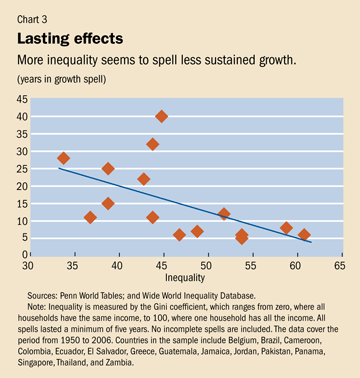
Such ambiguity fits perfectly with their actual data (so often a repository of key information missed by linear regression): high-inequality countries may not be able to sustain growth, but having relatively low inequality only makes sustained growth possible, not assured.
What should be obvious is that the ability of more or less income equality to translate into growth has to do not only with national trade law, or the frequency of elections, or the independence of the central bank. It also has to do with institutions. Strictly speaking, Berg and Ostry’s study, like much of the related literature from recent years, do not ignore institutions, or not exactly.
Somewhere in the background, Berg and Ostry know that institutional structures are at play. Their discussion of “distorted incentives” in Chinese farming policy makes this clear. they totally ignore the qualitative structure of institutions. But by referencing the “quality of economic and political institutions” , they seem to suggest that the role of institutions can be reduced to a single, numerical dimension. Good institutions give people incentives to work (or to save, or to “create jobs”, or to invest in human capital, or in new technology); bad incentives keep people lazy and greedy. Anyone who has had to wrestle with actual on-the-ground policy-making, though, knows that those incentives don’t always line up, and understanding institutions is at the very least about trying to see how people’s incentives coordinate in economic activities, not only whether individuals are inspired to serve the ends of growth.